The land
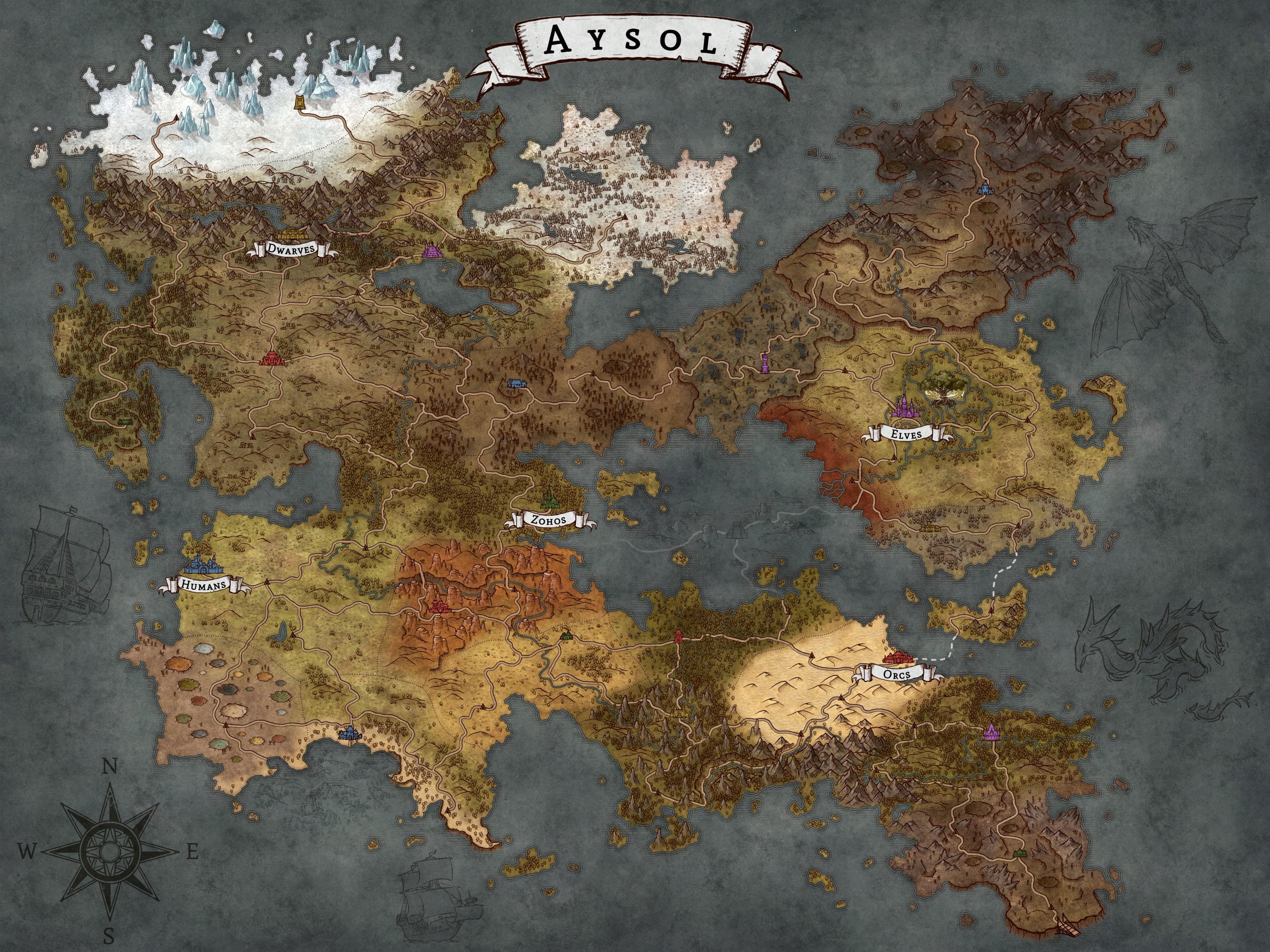
Aysol is a C-shaped continent wrapped around an inland sea, with a separate tundra island to the north. Its shape, peoples and scale are set. Exactly where every village, camp and bonfire sits is still being placed.
About half of the map is land — roughly 24.6 km². The real goal isn't a huge map, it's filling it with places worth walking to. A small full world beats a large empty one.
Regions
Regions are named for their spires, not for peoples — no region belongs to any one people. Difficulty is bound to the region, not to the player's level: each region carries its own band and grades from gentle at its settlements to hardest at its spire. A player may enter any region at any time; going there early is simply hard.
| Band | Region | Levels | Spire | Why this band |
|---|---|---|---|---|
| — | Heartland | 1–8 | none — the opening area, physical-only | The starting ground |
| 1 | South-west | 9–16 | 🌪️ Wind | Open coast and plains, the easiest ground to read and cross |
| 2 | East | 17–24 | 🪨 Earth | The largest region; the hero's ruined village lands mid-game |
| 3 | South-east | 25–32 | 💧 Water | Desert, the harshest ground to cross |
| 4 | North-west | 33–40 | 🔥 Fire | Ice field and mountains; the last and hardest spire |
| — | Tundra island | — | none | No role yet |
Opposites face each other across the inland sea: Fire (north-west) against Water (south-east), Earth (east) against Wind (south-west).
The overflow
Each Guardian's seal is failing and leaking raw elemental power. The overflow is local, not regional — it reaches only a few hundred metres around each spire. A region's look never matches its spire's element on purpose: fire in snow, a flood rising out of desert sand. The mismatch is what makes a failing seal visible from a distance.
| Spire | Where | What the overflow does |
|---|---|---|
| 🔥 Fire | The ice field, north-west | Fire that will not go out, burning in snow |
| 🪨 Earth | The great tree, east | The tree slowly turning to stone from the spire outward |
| 💧 Water | The pale desert, south-east | A flood rising out of dry sand, that will not drain |
| 🌪️ Wind | The basin of coloured pools, south-west | A gale lashing water that should lie still |
The heartland
The heartland sits where every road on the map meets, around the city — the one place where all four peoples live together. The heartland also takes in the northern canyons.
It holds the city, the keeper who offers the hero his first element, and all four awakening sites, each facing its own spire. The player need never leave the heartland until all four elements are held, which keeps the opening area's physical-only enemies in one controllable space.
The hero does not start in the city — the opening ambush wreck lies at the canyons' western mouth. See Lore and History for the story beat.
The first playable area
The south-east crossing, where the canyon country meets the forest hills at the foot of the southern chain. It is Water's awakening site — "a flooded crossing" — built around a stream, a waterfall, a ruined arch and a stone bridge, under oak, birch and pine.
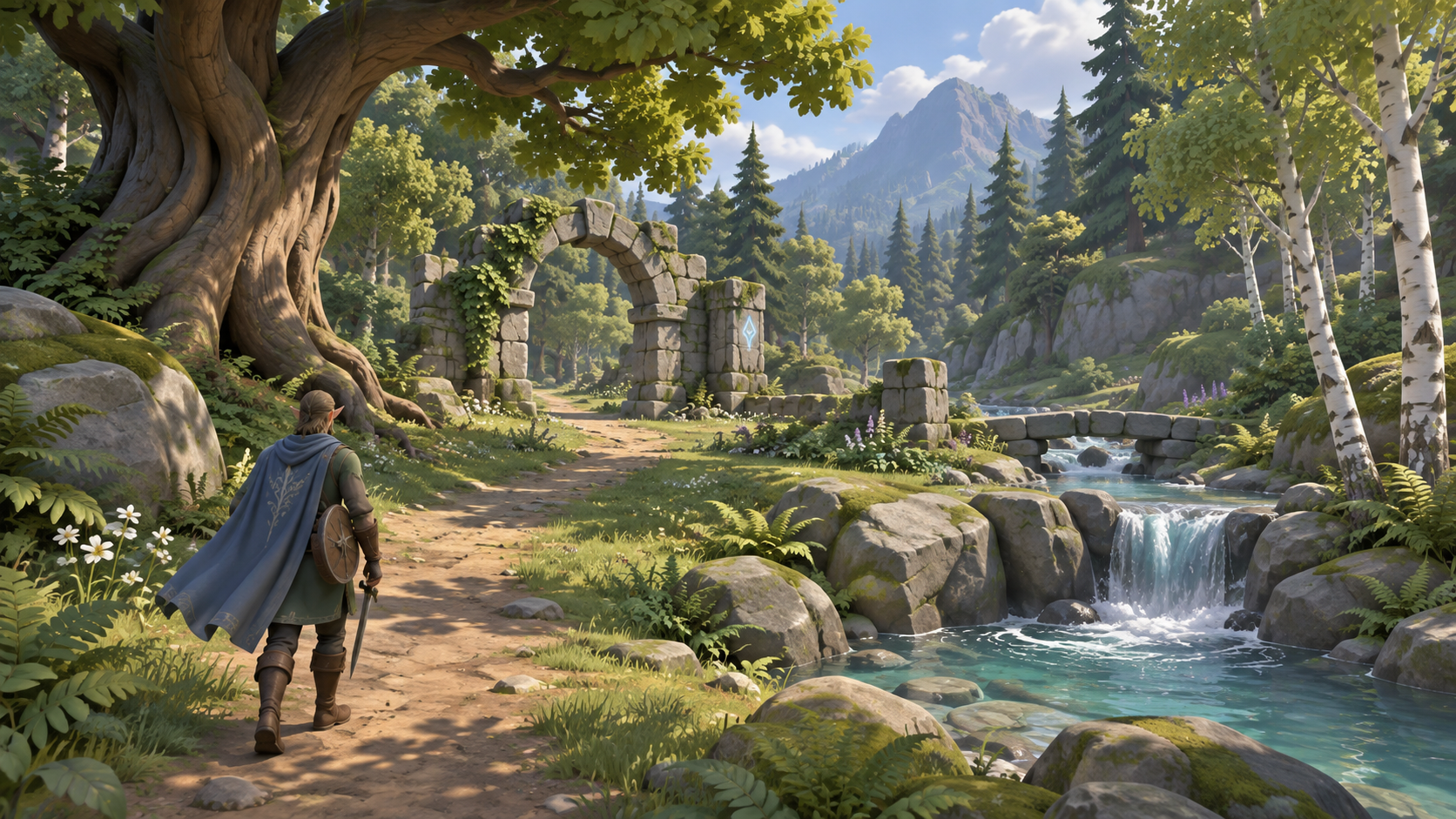
This area teaches, in order: the sword and lock-on, the shield (parry and block), the bow, climbing with stamina, and resting at a bonfire — all before any element wakes. It is physical-only, like the rest of the heartland. Leaving it toward the city, the hero reaches the burning red tower village, where Fire awakens if that was his first choice at the keeper.
Elevation
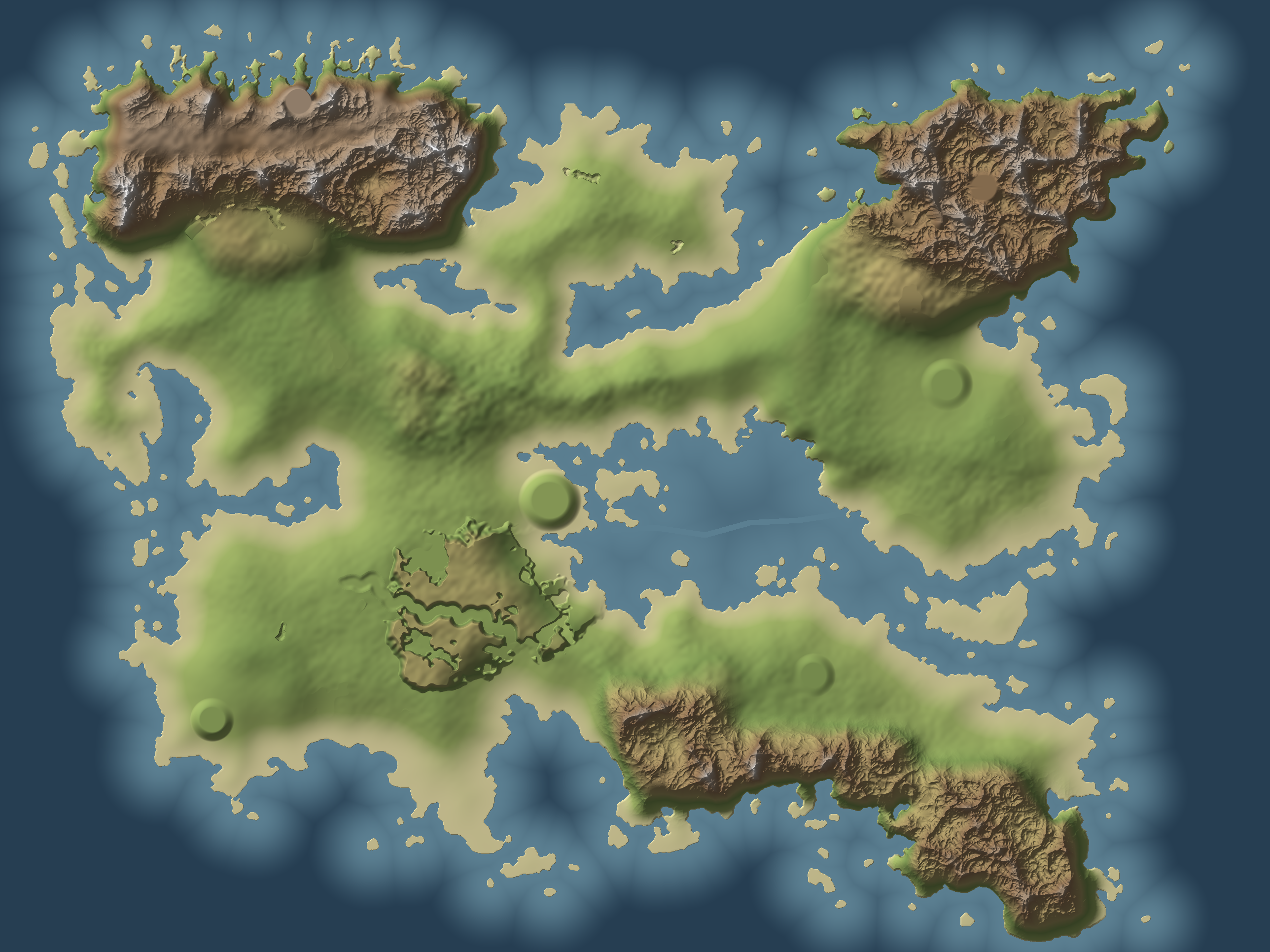
Sea level is 0; the highest peak is about 410 m. Three-quarters of the land lies below 100 m, so the heartland and plains read at a glance while the mountains frame the world from its edges.
| Region | Shape |
|---|---|
| Heartland | The city on a low shore; mesas cut by a gorge |
| North-west | An ice-field plateau behind a mountain wall; the dwarves' basin at its foot |
| East | Highlands stepping down to moor and golden plains; the tree in a shallow valley |
| South-west | A sand coast; the pool basin a shallow bowl |
| South-east | Desert against the southern mountain chain |
Climbing
The hero can climb any steep ground, at a stamina cost. Climbing drains stamina quickly while moving and more slowly while holding still; a base stamina bar covers roughly 15 metres of continuous climbing. Stamina does not regenerate on a wall, and running out means falling.
- Some surfaces cannot be climbed: overhangs, ice, rock polished wet by a waterfall or the sea, and the spires' warded stone — each reading clearly at a glance, with no invisible walls.
- Cold above the snow line: high in the north-west, stamina regenerates more slowly on ledges — making the ice field's wall the hardest climb in the game.
- Enemies do not climb. A climb cannot start for a few seconds after taking a hit, so a player cannot simply flee up a rock mid-fight — but archers and casters can still hit a climber.
- Passes and roads remain the safe route at no stamina cost; climbing is the shortcut, paid for in time and risk.
Travel
Fast travel is between bonfires already visited — bonfires double as the whole travel network. There are no mounts: with fast travel covering return trips, a mount solves no problem the map has.
Still in development — details may change
Spire height, the roles of the tundra island and the eastern sea route, and exactly how a failing spire looks from a distance are all still being worked out. See Lore and History for what's still open.