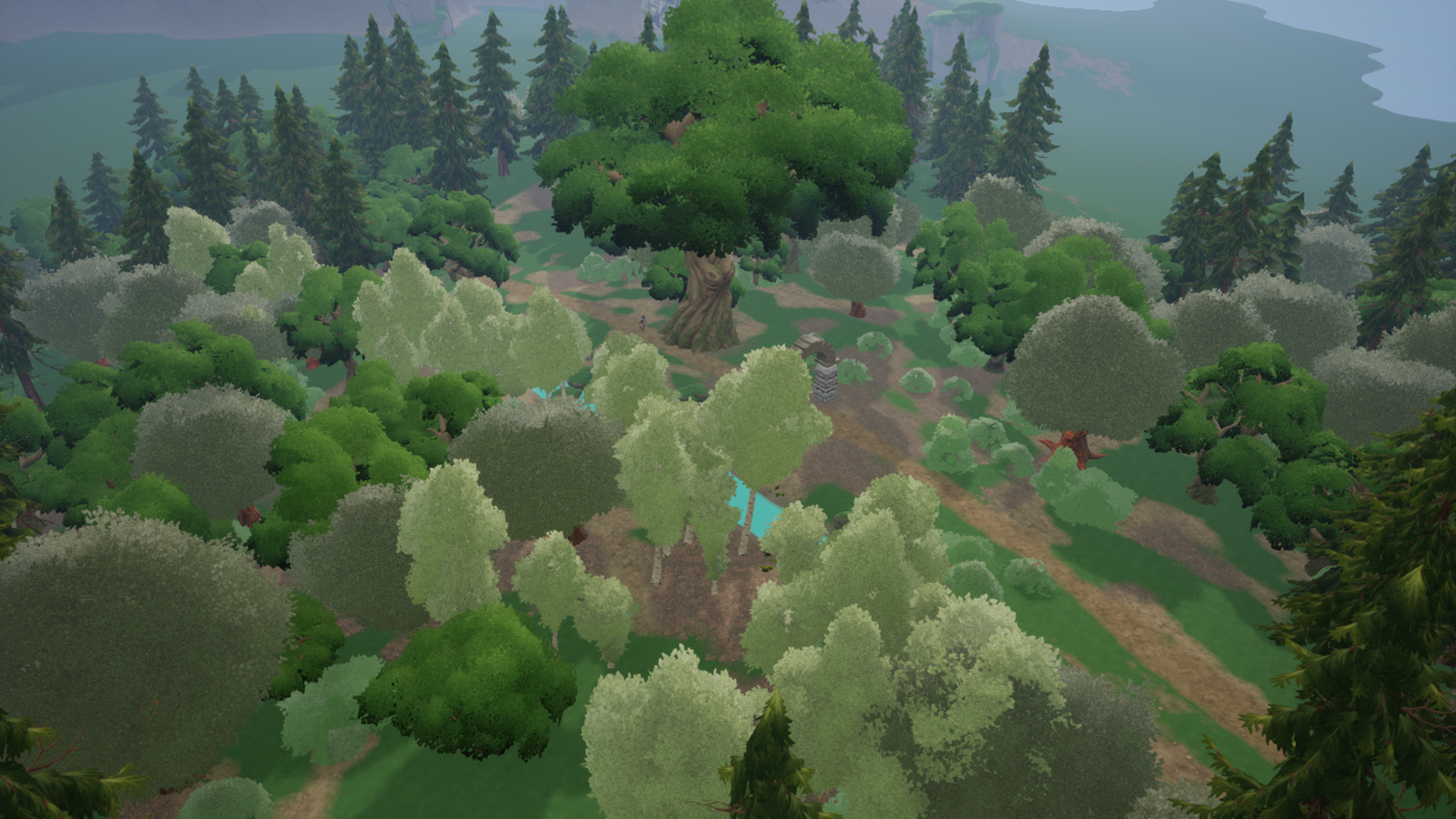
The premise
The land of Aysol was held in balance by four Elemental Guardians — Fire, Water, Earth and Wind. Centuries ago they sealed themselves into four great spires so their combined power could never be gathered in one place. That seal is failing.
There is no fifth force. Earlier drafts had a corrupting power — the Blight, or the Void — that twisted creatures and ate at the spires. It has been removed entirely, not renamed: it was borrowed from elsewhere, was never actually defined beyond "corruption spreads," and every job it did is already done by something else. The failing seal supplies the urgency and the through-line; the antagonist supplies the final enemy. A fifth invisible thing also competed for thematic space in a game named for four.
What is actually going wrong
The seal is not under attack. It is simply wearing out, and what escapes is raw elemental power with no Guardian left to govern it. The overflow is local, not regional — it reaches only a few hundred metres around each spire; see World and Regions for how each element's overflow looks and behaves.
The spreading threat is social. Everyone knows the seal is failing. Cults form around each spire convinced its power is owed to them, rival claimants race to reach the Guardians first, and ordinary order frays. This is where most of the world's danger actually comes from. See Characters and Factions.
Magic and the blood
Magic exists across Aysol and belongs to no people. Anyone can learn to cast by borrowing power from outside — an elemental source, or a charge carried from one. Borrowed magic is weaker than the hero's and usually holds only one element. The failing seal makes it stronger, because there is more leaking power to borrow — which is the in-world reason Aegis and the magic parry exist at all.
The hero's power is innate and borrows nothing. Sources amplify it, but it never depends on them. Mages of every people exist; nobody else has the hero's blood.
The heartland is the farthest point from every spire, so casters there are weak and rare — the in-world reason act one's enemies fight only physically.
Spoiler: Where the blood comes from — not known to the player until act two — click to reveal
The seal made the hero. Blood of a single element occurs rarely and naturally — that is who held one before him. Four elements has never happened, because four is not natural: the failing seal is trying to replace itself. When it broke through at the Earth spire, the child in the village beside it was what it reached for. The overflow that took the village did not kill the child — it filled him. The antagonist took four by force and is overfull; the hero was made to hold them.
- Chance, not destiny. No prophecy, bloodline or merit — the hero was simply the nearest child when the seal reached. Everything after is not chance, and the finale is the one thing the hero actually chooses.
- It answers why the hero survived the ambush that opens the game: the bandits did not spare him, they left him for dead, and the blood did not let him die.
- Both opponents are right, differently. The restorers are right that the hero is a vessel; the antagonist is right about what that costs.
- The antagonist says this out loud in act two, and is not believed.
The hero
See The Hero for his full profile. In outline: a male human orphan, born in the stone-taken village, raised on the road by a mixed caravan, around twenty when the game begins, hunted immediately by two parties for different reasons.
The opening
The hero starts alone. A caravan crossing into the heartland on an old trade road is ambushed by bandits, and he wakes in the wreckage as the only survivor. The arc runs from alone, to one person, to a city, to the world — a crowded starting city would have skipped the first two steps.
- The first person the hero meets is a keeper, not a crowd — so the world opens on its helpful side before the hunt begins. See the keepers.
- The city comes later, as a deliberate step into society, not the place the game begins.
- The ambush supplies act one's physical-only threat, and gives the heartland's bandit chief a personal reason to be its boss: they did this.
- One question hangs from the first minute — why was the hero the one left alive? Act one does not answer it; the antagonist does, in act two.
The Guardians
See Enemies and Guardians for how they appear in combat. They sealed themselves to contain their own power, and centuries of containing it has done to them exactly what the overflow does to everything else. They are the first victims of their own solution, not villains — and killing one simply ends its leak.
Spoiler: The antagonist — click to reveal
A former wielder who gathered all four elements into himself alone, survived, and is overfull — a living example of the failure state the Guardians feared. He is not corrupted; there is nothing wrong with him that is not simply too much.
He is right. He hunts the hero because he understands exactly what the hero is and what the ending will ask of them, and nobody believes him — including the player. That is the point: the finale works precisely because he was correct all along. He has also tried to make others like himself, and failed, producing the two-element wrecks described on the Enemies page — dangerous, pitiable, and a preview of what fusion does, long before the finale asks the hero to do it on purpose.
Act structure
Spoiler: Full act structure, including the finale — click to reveal
Five acts and a finale. Act one is the heartland; acts two to five are the four spire regions, one each, in whatever order the player chooses. Story beats follow the order of arrival, not a fixed place — "act two" is simply whichever region the player enters second. Difficulty belongs to the region, not the act.
| Act | Beat |
|---|---|
| One | The heartland. The hero wakes alone, the sole survivor of the ambush, with no element, only sword and bow. The first person met is an old keeper, who offers a veiled choice between the four elements; the hunt begins within hours of the first awakening. All four elements are held in their quick form by the act's end, the bandit chief is dead, and the city is reached. |
| Two | The first spire region. Its Guardian is the most lucid: it explains what the seal is and asks for the ending. The antagonist appears in person, as a warning rather than a threat, tells the hero where the blood comes from, and is not believed. |
| Three and four | Two more regions. Each Guardian is less coherent, each site's overflow is worse, and the cults grow more organised. The city's trade compact frays with each act. |
| Five | The last spire. No conversation. The hero now carries all four elements fully — already further than anyone has ever gone. |
| Finale | The antagonist. Beating him requires fusion, which is the exact act that destroyed him and the exact thing four Guardians died to prevent. The hero does the forbidden thing knowingly. |
The Four Spires
The four Guardian sites are spires — tall vertical towers rising well above the landscape — not small or buried shrines. Each spire's interior sanctum is the dungeon and Guardian boss arena; "spire" names the exterior structure, "sanctum" the space inside it. This does real gameplay work: the HUD has no minimap, so the spires are the primary navigation system — the player reads position from which spires are visible and how they sit relative to each other. See World and Regions for where each stands.
Carried in, but undecided
Elemental fusion is an idea only — nothing about it is decided or scoped beyond the finale. The concept under discussion: pairs of elements combine — Fire and Water into steam, Water and Wind into ice, Fire and Earth into lava, Earth and Wind into a sandstorm. Directions discussed but not adopted: combos triggered by casting one spell into another's effect rather than a new input, and a distinction between combining two elements in the world (safe) versus fusing all four inside a body (the finale's forbidden act). These pairs already shape the talent disc's border links.
Naming
The game and the world are both called Aysol.
Still in development — details may change
Still open: the antagonist's name, names for the claimants' branches, the restorers and the keepers, individual spire names, and exactly how a failing spire looks from a distance.